ASAD News • Somaliland • Hargeisa
In Hargeisa, a Graduate Carries Two Flags — and a Generation’s Hopes
A young woman’s graduation photo, blending Somaliland’s flag with Israel’s, has become an unlikely symbol of a nation still waiting to be recognized — and of a youth generation asking what recognition might finally deliver.
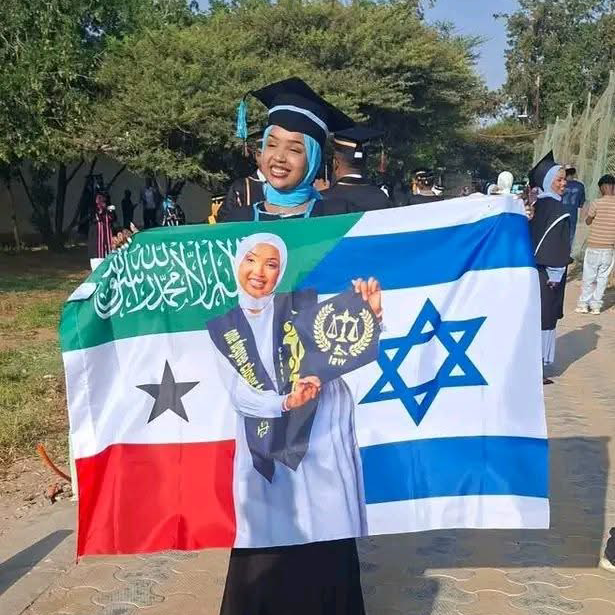
HARGEISA, Somaliland — At a university commencement in this city of roundabouts and camel markets, a graduate in a black gown and turquoise hijab held up two flags at once: the green, white and red of Somaliland, and the blue and white of Israel, their fabric literally sewn together. The image, circulating quietly among the Somaliland diaspora, captures something larger than one student’s pride. It captures a generation’s bet on what recognition could mean for their futures.
Somaliland’s story begins on June 26, 1960, when British Somaliland gained independence and was recognized by roughly three dozen states, including Israel. Days later, on July 1, it voluntarily united with the former Italian Somaliland to form the Somali Republic — a union born of pan-Somali idealism that collapsed into dictatorship under Siad Barre and, eventually, civil war. In 1991, after a bruising liberation struggle, Somaliland’s clans convened and reclaimed the sovereignty it had briefly held three decades earlier, withdrawing from the union with the south.
In the thirty-plus years since, Somaliland has built what political scientists call a hybrid democracy — an elected presidency and parliament layered atop a traditional council of clan elders. It has seated six presidents, weathered several closely contested elections, and, notably, seen incumbents concede defeat and hand over power peacefully — a rarity in the Horn of Africa. Independent observers routinely rank it among the region’s safest and most stable territories, despite receiving no formal diplomatic recognition from any UN member state for most of its existence.
That changed on December 26, 2025, when Israel became the first United Nations member to formally recognize the Republic of Somaliland as an independent, sovereign state, with plans to exchange ambassadors and expand cooperation in agriculture, health and technology. It was, in a sense, a second recognition: Israel had also recognized Somaliland’s brief 1960 independence. Somalia’s government in Mogadishu, along with Egypt, Turkey and members of the Arab League, denounced the move as a violation of Somali sovereignty, and it prompted a sharp debate at the UN Security Council. The dispute is real, and unresolved.
For many young Somalilanders, the politics are inseparable from economics. Roughly 70 percent of the country’s population is under 30, and youth unemployment has hovered near 75 percent for over a decade, driving waves of graduates toward migration in search of work. Universities in Hargeisa turn out engineers, lawyers and accountants each year with few local jobs and little access to the international banking, investment or aid networks that flow easily to recognized states. For a graduate holding two flags, the gesture reads less as a statement on Middle East politics than as a plea: that recognition might open doors — trade, credit, opportunity — that isolation has kept shut.
Some in the wider Somali world have reacted to images like hers with discomfort, reading an embrace of Israel as a betrayal of solidarity. Left unsaid is the more basic fact of Somaliland’s three-decade campaign for acknowledgment, pursued through democratic governance rather than force. It is also worth noting that Somaliland’s population is overwhelmingly Muslim, and that faith has not stood in the way of partnership — millions of observant Muslims live, work and worship with full respect in the United States, Europe and elsewhere. A diplomatic relationship with Israel does not require abandoning that identity.
ASAD (American Somaliland Association for Development) does not ask anyone to adopt a single view of this moment. We do believe that a young woman photographed at her own graduation has the right — as an individual, and as a member of a family and a nation — to say plainly what she believes will serve her future. For her and for many of her classmates, that future depends on Somaliland being seen, at last, by the world it has long asked to see it.
ASAD is a Virginia-registered 501(c)(3) nonprofit supporting development.